Cambridge Lower Secondary · Science 0893 · Stage 8 · Chemistry
Purity, Concentration and Chromatography
What purity means and how to calculate it, how concentration depends on the number of solute particles in a volume, and how to carry out and read paper chromatography.
British & IGCSE › Checkpoint 8 › Checkpoint 8 Science — Complete Course
- Know that purity describes how much of one particular chemical is in a sample. (8Cm.04)
- Understand that the concentration of a solution depends on how many solute particles are in a volume of the solvent. (8Cp.01)
- Describe how paper chromatography separates the substances in a sample and helps identify them. (8Cp.02)
1. Key words
| Word / phrase | Meaning / use |
|---|---|
| pure substance | مادة نقية — contains only one chemical (one type of particle) |
| impure | غير نقي — contains small amounts of other substances |
| impurity | شائبة — an unwanted substance mixed in |
| mixture | مخلوط — two or more substances mixed but not joined chemically |
| purity | درجة النقاء — how much of the wanted chemical is in a sample |
| solute | المذاب — the substance that dissolves |
| solvent | المذيب — the liquid that the solute dissolves in |
| solution | محلول — a solute dissolved in a solvent |
| concentration | التركيز — how many solute particles are in a certain volume |
| dilute / concentrated | مخفف / مركز — few / many solute particles in the same volume |
| chromatography | الكروماتوجرافيا (الفصل اللوني) — a method to separate and identify dissolved substances |
| chromatogram | الكروماتوجرام — the paper with the separated spots at the end |
2. What does "pure" mean in science?
In everyday language "pure" often means "natural" or "with nothing added" — a carton may say "100% pure orange juice". In science, a pure substance contains only one chemical. Orange juice contains water, sugars, acids and vitamins, so a scientist calls it a mixture.
Most real samples are not perfectly pure. They contain small amounts of other substances called impurities. Purity describes how much of the specific chemical you want is in the sample. A sample that is 99% pure is almost all the wanted chemical; one that is 60% pure contains a lot of other substances.
| Example | Why purity matters |
|---|---|
| Medicines | Impurities could be harmful, so medicines must be extremely pure and are tested carefully. |
| Drinking water | Tap water is not pure (it has dissolved minerals) but it must be free from harmful impurities such as microorganisms and toxic metals. |
| Gold jewellery | 24 carat gold is pure gold. 18 carat gold is 18/24 = 75% gold; other metals are added to make it harder. |
| Table salt | Salt from the sea is purified to remove sand and other salts. |
3. Calculating percentage purity
When you know the mass of the wanted chemical in a sample, you can work out its purity as a percentage:
percentage purity = (mass of the wanted chemical ÷ total mass of the sample) × 100
- Find the mass of the wanted chemical (sometimes you must subtract the mass of the impurities first).
- Divide by the total mass of the sample.
- Multiply by 100 and write the % sign.
You can also use particles: if 16 out of 20 particles are the wanted substance, purity = 16 ÷ 20 × 100 = 80%.
A pure substance melts and boils at fixed temperatures. For example, pure water boils at 100 °C (at normal air pressure) — salty water boils at a higher temperature. So if a sample melts or boils at a different temperature, or over a range of temperatures, it is probably impure. Chromatography (section 6) is another check: a pure substance gives only one spot.
4. Concentration of a solution
When a solute (such as sugar) dissolves in a solvent (such as water) it makes a solution. The solute particles spread out between the solvent particles. The concentration tells you how many solute particles there are in a certain volume of solvent.
- More solute particles in the same volume → more concentrated.
- The same number of solute particles in a bigger volume → more dilute (less concentrated).
- To dilute a solution, add more solvent. The number of solute particles stays the same, but they are spread through more liquid.
- To make a solution more concentrated, dissolve more solute in it, or evaporate some of the solvent.
- For a coloured solution, a more concentrated solution usually looks darker (more coloured particles in each cm³).
Comparing concentrations with numbers. Always compare the mass of solute in the same volume. For example, 10 g of sugar in 50 cm³ of solution is the same concentration as 20 g in 100 cm³ (double both). 15 g in 100 cm³ is less concentrated than that.
النقاء (purity) = قد إيه من المادة اللي إحنا عايزينها موجود في العينة. المادة النقية فيها نوع واحد بس من الجسيمات. التركيز (concentration) = عدد جسيمات المذاب في حجم معين من المذيب: جسيمات أكتر في نفس الحجم = محلول مركز أكتر. لو زودت ماء، عدد جسيمات المذاب مش بيتغير، لكن بتتوزع في حجم أكبر فيبقى المحلول مخفف أكتر.
5. How paper chromatography works
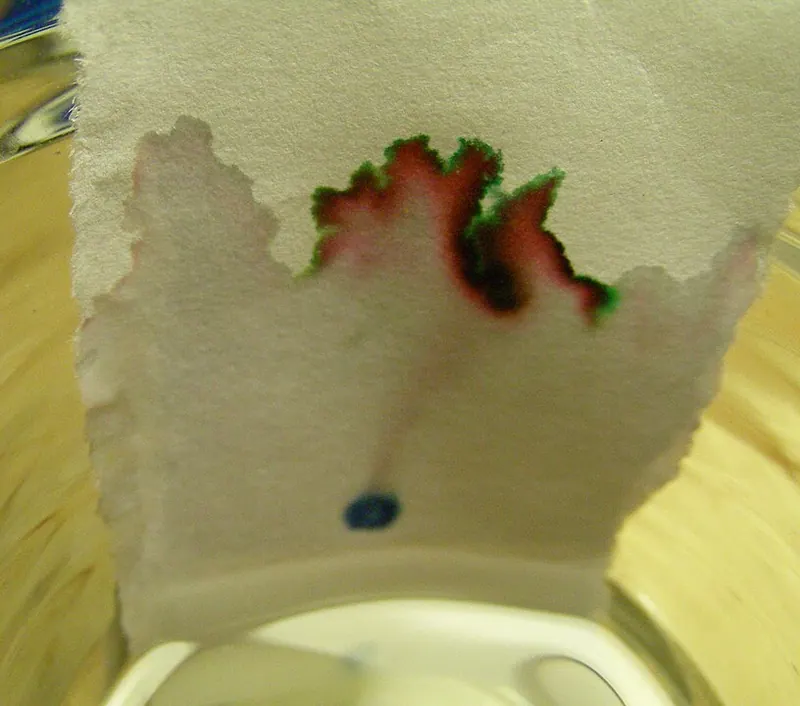
Many coloured substances — inks, food colourings, plant dyes — are really mixtures of several dyes. Paper chromatography separates them so you can see how many substances are present and identify them.
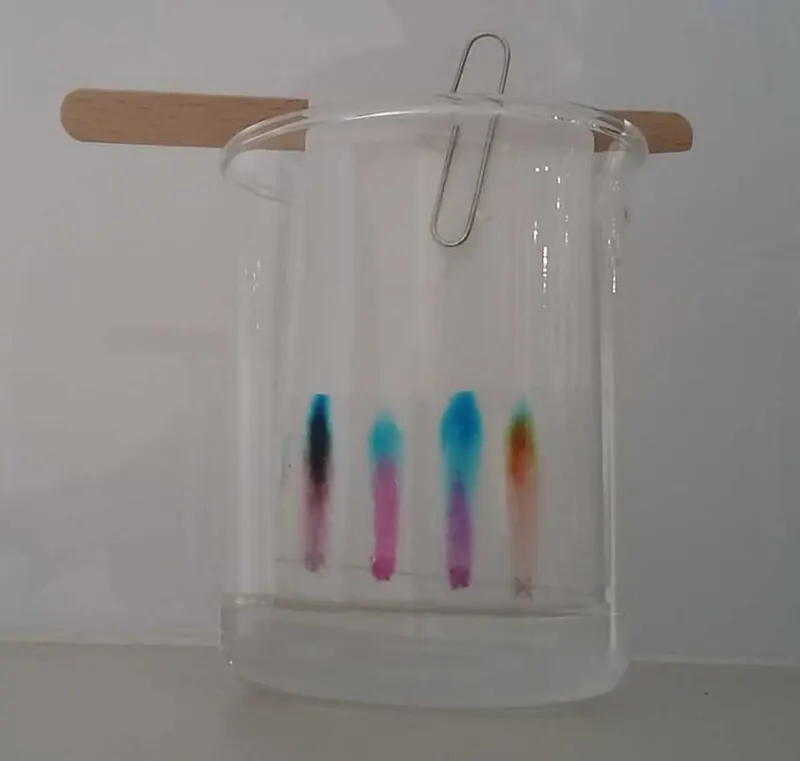
- Draw a start line in pencil about 2 cm from the bottom of the chromatography paper. (Pencil does not dissolve, so it will not move or add spots.)
- Put a small, concentrated spot of each sample on the line, spaced apart. Label each one in pencil under the line.
- Pour a little solvent (often water or ethanol) into a beaker. Hang the paper so the bottom dips into the solvent but the solvent level is below the start line.
- Cover the beaker with a lid so the solvent does not evaporate.
- The solvent soaks up the paper. As it passes the spots, it dissolves the substances and carries them upwards. Substances that are more soluble in the solvent travel further; less soluble ones travel a shorter distance.
- Take the paper out before the solvent reaches the top. Mark how far the solvent got (the solvent front) in pencil, then let the paper dry. The dried paper with its spots is the chromatogram.
Ethanol is flammable — keep it away from flames. Wear eye protection, and do not touch the spots or eat the food colourings used.
6. Reading a chromatogram
- Each spot is one substance. The number of spots tells you the (minimum) number of substances in a sample. X has 2 spots, so it contains at least 2 substances.
- A pure substance gives one spot. A, B and C each give one spot, so each could be a single substance.
- Same height = same substance (on the same paper with the same solvent). X has spots level with A and B, so X contains A and B. Y has a spot level with C, so Y contains C.
- A spot left on the start line is a substance that is insoluble in this solvent — it did not move. Y contains an insoluble substance as well as C.
- If a spot in the unknown matches none of the known samples, the unknown contains a substance that was not tested.
Chromatography is used to identify food colourings, to check if a medicine is pure, to test athletes for banned substances, and by forensic scientists to match the ink on a document to a particular pen.
7. Worked examples
Worked example 1 — A 40 g sample of rock salt contains 2 g of sand. The rest is salt. Calculate the percentage purity of the salt. [2]
- Mass of salt = 40 − 2 = 38 g.
- Purity = (38 ÷ 40) × 100 = 95% (1 mark working, 1 mark answer).
- Common mistake: using the 2 g of sand: (2 ÷ 40) × 100 = 5% is the percentage of impurity, not the purity.
Worked example 2 — A particle diagram of a gas sample shows 25 particles: 20 are oxygen and 5 are nitrogen. (a) Is the oxygen pure? [1] (b) Calculate the percentage purity of the oxygen. [1]
- (a) No — it contains nitrogen particles (an impurity) as well as oxygen.
- (b) 20 ÷ 25 × 100 = 80%.
Worked example 3 — Solution A has 10 g of salt in 50 cm³. Solution B has 15 g of salt in 100 cm³. Which is more concentrated? Show how you decide. [2]
- Make the volumes the same: A = 10 g in 50 cm³ = 20 g in 100 cm³. B = 15 g in 100 cm³ (1).
- 20 g > 15 g in the same volume, so A is more concentrated (1).
- Common mistake: choosing B because 15 g is more than 10 g, without looking at the volume.
Worked example 4 — Explain, using particles, what happens to the concentration of a squash drink when you add more water. [2]
- The number of solute (squash) particles stays the same (1).
- They are spread through a larger volume of water, so there are fewer solute particles in each cm³ — the drink becomes more dilute (less concentrated) (1).
Worked example 5 — Use the chromatogram in section 6. (a) How many substances are in X? [1] (b) Which known dyes are in X? [1] (c) What does the spot on the start line for Y show? [1]
- (a) 2 (two spots).
- (b) A and B — X's spots are at the same heights as A's and B's spots.
- (c) Y contains a substance that is insoluble in the solvent, so it did not move.
- Exam tip: say "at the same height" or "travelled the same distance" — not just "the same".
Worked example 6 — Omar sets up chromatography. He draws the start line in felt-tip pen and pours the solvent in until it is 1 cm above the line. Describe two mistakes and explain why each is a problem. [4]
- Mistake 1: the line is in ink (1). The ink would dissolve and separate into its own spots, mixing with the results (1).
- Mistake 2: the solvent is above the start line (1). The samples would dissolve into the solvent in the beaker instead of moving up the paper (1).
- Exam tip: a "describe and explain" question needs what is wrong and why — 2 marks each.
- Calling a natural product like "pure honey" or "pure juice" a pure substance — in science these are mixtures.
- Working out the percentage of impurity when the question asks for the purity.
- Comparing concentrations without making the volumes the same.
- Thinking that adding water removes solute particles — the number of solute particles stays the same.
- Confusing dilute with dissolve. Dissolve = the solute mixes into the solvent; dilute = add more solvent.
- Saying a spot on the start line "was not tested" — it means the substance is insoluble in that solvent.
- Drawing the start line in ink, or letting the solvent cover the spots.
- Draw particle diagrams of a pure substance and an impure sample (use different shapes or shading and a key).
- Calculate a percentage purity — show the division and the × 100.
- Circle the most concentrated / most dilute solution from particle diagrams or from masses and volumes.
- Explain dilution using the words particles, same number, larger volume.
- Label the chromatography apparatus and explain why the line is in pencil and the solvent is below it.
- Read a chromatogram: how many substances, which known dyes match, which sample is pure, which contains an insoluble substance.
Practice
- A pure substance contains only one chemical. Purity = how much of the wanted chemical is in a sample.
- Percentage purity = mass of wanted chemical ÷ total mass × 100.
- Concentration = how many solute particles are in a volume of solvent. Adding solvent dilutes; the number of solute particles stays the same.
- Chromatography: pencil start line, small spots, solvent below the line, lid on. More soluble substances travel further.
- One spot = one substance; same height = same substance; a spot on the start line = insoluble in that solvent.
All pages in this course
Start here
- Stage 8 Science: The Tests and How to Prepare
- Thinking and Working Scientifically: Models, Investigations and Analysing Results
Biology
- Joints and Antagonistic Muscles
- Blood and Its Components
- Breathing, Gas Exchange and Diffusion in the Lungs
- A Balanced Diet, Energy Stores and Lifestyle
- Aerobic Respiration
- Ecosystems, Bioaccumulation and Invasive Species
Chemistry
- The Structure of the Atom
- Purity, Concentration and Chromatography
- Word Equations, Exothermic and Endothermic Reactions
- The Reactivity of Metals
- Impure Products and Solubility of Salts
Physics
- Speed and Distance–Time Graphs
- Balanced and Unbalanced Forces, and Moments
- Pressure, Particles and Diffusion
- Reflection and Refraction
- Dispersion and Colour
- Magnetic Fields and Electromagnets
Earth and space
- The Earth's Magnetic Field and Earth's Resources
- Climate, Weather and Climate Change
- Galaxies and Asteroids
Practice tests