Cambridge Lower Secondary · Science 0893 · Stage 8 · Earth and Space
Galaxies and Asteroids
What a galaxy is made of — stars, planetary systems, dust and gas — and how asteroids formed from rocks left over when the Solar System formed, with diagrams, worked examples and a Checkpoint-style quiz.
British & IGCSE › Checkpoint 8 › Checkpoint 8 Science — Complete Course
- Describe a galaxy: a huge group of stars and planetary systems, with clouds of dust and gas between them (stellar dust and gas). (8ESs.01)
- Describe asteroids as rocks that are smaller than planets, and explain that they formed from rocks left over when a planetary system formed. (8ESs.02)
1. Key words
| Word / phrase | Meaning / use |
|---|---|
| star | نجم — a huge ball of hot gas that gives out its own light, like the Sun |
| planet | كوكب — a large, round object that orbits a star and does not give out its own light |
| orbit | مدار / يدور حول — the path of one object around another |
| planetary system | نظام كوكبي — a star and all the planets and smaller objects that orbit it |
| Solar System | المجموعة الشمسية — our planetary system: the Sun, eight planets, moons, asteroids and comets |
| galaxy | مجرة — a huge group of stars, planetary systems, dust and gas held together by gravity |
| the Milky Way | درب التبانة — the galaxy we live in |
| stellar dust | غبار نجمي — tiny solid grains floating between the stars |
| nebula (plural nebulae) | سديم — a cloud of dust and gas in space where new stars form |
| gravity | الجاذبية — the force of attraction between all objects with mass |
| asteroid | كويكب — a rocky object, smaller than a planet, that orbits the Sun |
| asteroid belt | حزام الكويكبات — the region between Mars and Jupiter where most asteroids orbit |
| Universe | الكون — everything that exists: all the galaxies and the space between them |
2. What is a galaxy?
A galaxy is an enormous group of stars, planetary systems and clouds of dust and gas, all held together by gravity. Our Sun is just one star in a galaxy called the Milky Way.
| Part of a galaxy | What it is |
|---|---|
| Stars | Huge balls of hot gas that give out light. A galaxy can have millions to hundreds of billions of stars. The Milky Way has more than 100 billion. |
| Planetary systems | Many stars have planets and other objects orbiting them. Our planetary system is the Solar System. Astronomers have already found more than 6000 planets orbiting other stars. |
| Stellar dust | Tiny solid grains (a bit like soot and very fine sand) spread between the stars. |
| Gas | Mostly hydrogen and helium. Where dust and gas gather into big clouds (nebulae), gravity can pull them together to make new stars and planets. |
A galaxy is a very large group of stars and their planetary systems, with dust and gas between them, held together by gravity.
3. Our galaxy — the Milky Way
The Milky Way is a spiral galaxy: from above it would look like a flat, spinning disc with a bulge of stars in the centre and long curved spiral arms. The arms are full of stars, dust and gas. The Sun is in one of the arms, about halfway from the centre to the edge.
- The Milky Way is about 100 000 light-years across. A light-year is the distance light travels in one year — about 9.5 million million km. Light is the fastest thing there is, yet it would take 100 000 years to cross our galaxy.
- The Sun takes about 230 million years to travel once around the centre of the galaxy.
- On a very dark night, far from city lights (for example in the Western Desert or Sinai), you can see the Milky Way as a pale band of light across the sky. That band is the light of billions of distant stars in the disc of our galaxy, seen from the inside.
- The dark patches in the band are clouds of dust blocking the light of the stars behind them.
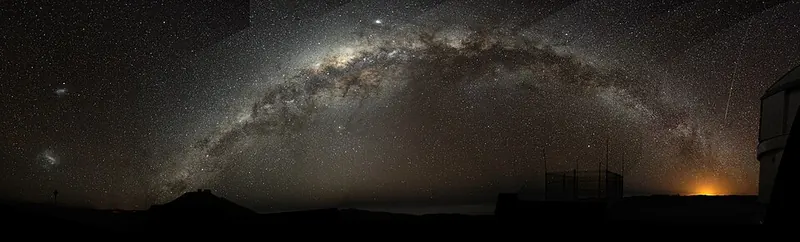
Other galaxies: the Universe contains at least hundreds of billions of galaxies. They have different shapes:
| Type | Shape | Example |
|---|---|---|
| Spiral | Flat disc with spiral arms and a central bulge | The Milky Way; the Andromeda Galaxy (about 2.5 million light-years away) |
| Elliptical | Smooth, oval or round ball of stars, with little dust and gas | Many of the largest galaxies |
| Irregular | No clear shape | The Large and Small Magellanic Clouds, small galaxies near the Milky Way |
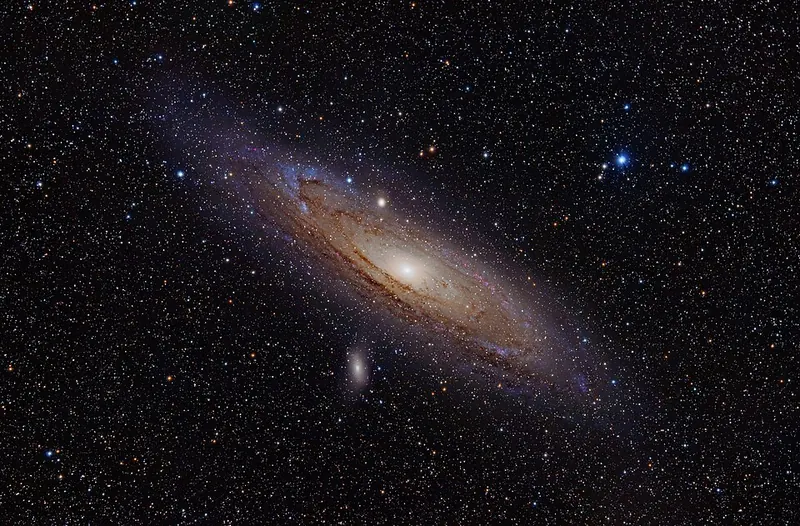
It helps to see how all these objects fit inside each other:
المجرة = مجموعة ضخمة جدًا من النجوم والأنظمة الكوكبية (نجم وحواليه كواكب) وغبار وغاز بين النجوم، وكلهم مربوطين ببعض بـالجاذبية. إحنا عايشين في مجرة اسمها درب التبانة، والشمس نجم واحد بس من أكتر من ١٠٠ مليار نجم فيها. الترتيب من الأصغر: كوكب ← نجم ← نظام كوكبي ← مجرة ← الكون.
4. What is an asteroid?
An asteroid is a lump of rock (some also contain a lot of metal, such as iron and nickel) that orbits the Sun. Asteroids are much smaller than planets. Most are not round: they are lumpy, like potatoes, because their gravity is too weak to pull them into a ball.
| Asteroid | Approximate diameter |
|---|---|
| Ceres (the largest; now also called a dwarf planet) | 940 km |
| Vesta | 525 km |
| Pallas | 510 km |
| Most asteroids | less than 1 km |
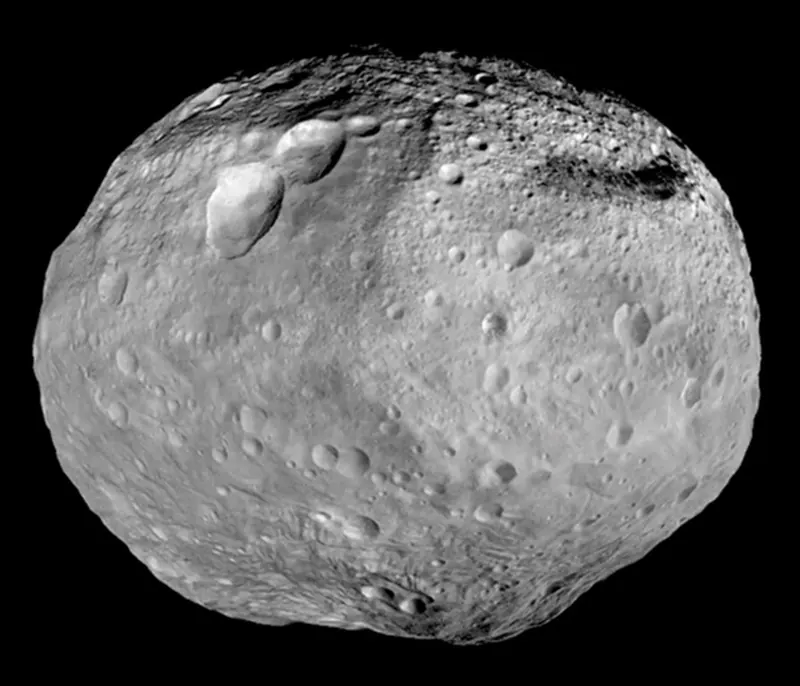
Compare these with the Earth, which is about 12 700 km across. Even all the asteroids in the asteroid belt put together have only a few per cent of the mass of our Moon.
- Most asteroids orbit the Sun in the asteroid belt, between the orbits of Mars and Jupiter. There are more than a million asteroids bigger than 1 km there.
- In films the asteroid belt is crowded, but really the asteroids are very far apart — spacecraft have flown through it without hitting anything.
- Some asteroids have orbits that come close to the Earth. About 66 million years ago an asteroid roughly 10 km wide hit the Earth, and scientists link it to the extinction of the dinosaurs. Today astronomers track near-Earth asteroids, and in 2022 a spacecraft (the DART mission) crashed into a small asteroid and changed its orbit.
| Object | What it is | Do not confuse because… |
|---|---|---|
| Asteroid | Rock (and metal) orbiting the Sun, smaller than a planet | — |
| Comet | A lump of ice and dust; it grows a glowing tail when it comes close to the Sun | Comets are icy, asteroids are rocky |
| Meteor | The streak of light ("shooting star") made when a small piece of rock burns up in the Earth's atmosphere | A meteor is the light, not the rock |
| Meteorite | A piece of space rock that lands on the Earth's surface | Many meteorites are small pieces of asteroids |
5. How asteroids formed
To understand asteroids, look at how a planetary system such as the Solar System forms. Scientists think this happened about 4.6 billion years ago:
- A huge cloud of dust and gas (a nebula) in the galaxy began to collapse because of gravity.
- As it shrank, it began to spin and flattened into a disc.
- Most of the material was pulled to the centre and became hot enough to form a star — the Sun.
- In the disc, dust grains stuck together to make small rocks; rocks crashed together and joined to make bigger rocks; the biggest pulled in more material by gravity and grew into planets.
- Not all the rocks became part of a planet. The rocks left over are the asteroids.
- Between Mars and Jupiter, the very strong gravity of the giant planet Jupiter kept stirring the rocks up, so they crashed and broke instead of joining together. That is why there is an asteroid belt there instead of another planet.
Because asteroids have hardly changed since then, they are like time capsules. Spacecraft from Japan and the USA have collected tiny samples from asteroids and brought them back to the Earth to learn what the early Solar System was made of.
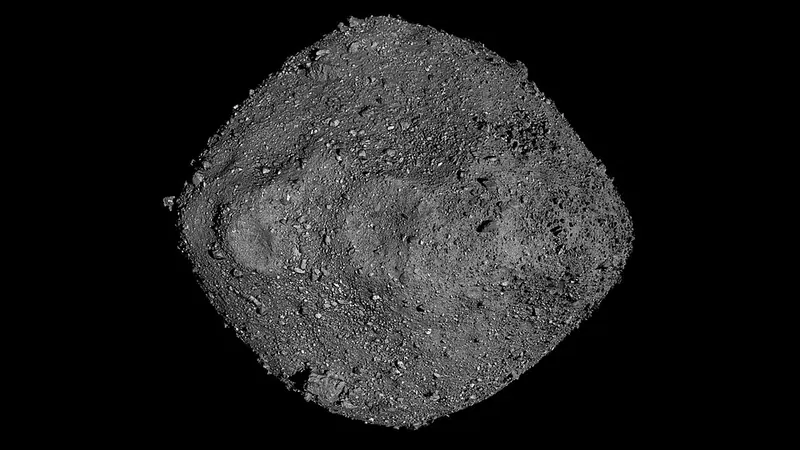
الكويكب = صخرة (وأحيانًا فيها معادن) بتدور حوالين الشمس، وأصغر بكتير من الكواكب. أغلب الكويكبات في حزام الكويكبات بين المريخ والمشتري. اتكونت من الصخور اللي فضلت بعد ما الكواكب اتكونت من سحابة الغبار والغاز، وجاذبية المشتري منعتها تتجمع وتعمل كوكب.
6. Worked examples
Worked example 1 — Describe what a galaxy is made of. [3]
- Stars (1).
- Planetary systems / planets orbiting stars (1).
- Dust and gas (clouds of stellar dust and gas) (1).
- Extra detail that helps: they are all held together by gravity.
- Common mistake: "a galaxy is a group of planets". Planets are only part of it — the main things are stars, plus dust and gas.
Worked example 2 — Write these in order of size, starting with the smallest: galaxy, planet, Universe, star, planetary system. [2]
- Think about what is inside what: a planet orbits a star; a star with its planets is a planetary system; billions of these make a galaxy; all the galaxies are in the Universe.
- Answer: planet → star → planetary system → galaxy → Universe (2 marks; 1 mark if only one pair is swapped).
- Common mistake: putting the Solar System before the Sun. The Solar System *contains* the Sun, so it is bigger.
Worked example 3 — Give two ways in which asteroids are different from planets. [2]
- Any two: asteroids are much smaller (1); most are not round / irregular in shape (1); there are millions of asteroids but only eight planets (1); most asteroids orbit together in a belt, but each planet has its own orbit (1).
- Exam tip: "Asteroids are rocks" is not a difference by itself — Mercury, Venus, Earth and Mars are rocky too. Say smaller.
Worked example 4 — Describe how the asteroids in the asteroid belt formed. [3]
- The Solar System formed from a cloud of dust and gas; the dust stuck together to make rocks (1).
- Most rocks joined together to make planets, but some were left over — these are the asteroids (1).
- Between Mars and Jupiter, Jupiter's gravity stopped the rocks from joining to form a planet (1).
- Common mistake: "asteroids are pieces of a planet that exploded". There is no evidence for this; they are left-over building material.
Worked example 5 — The Earth's diameter is about 12 700 km. Vesta's diameter is about 525 km. How many times wider is the Earth than Vesta? Give your answer to the nearest whole number. [2]
- 12 700 ÷ 525 (1)
- = 24.19… ≈ 24 times (1)
- This shows why asteroids are described as much smaller than planets.
Worked example 6 — A teacher says: "The Milky Way is like a huge city. Each house is a planetary system, and the people in the house are the star and its planets." (a) Give one way the analogy is useful. [1] (b) Give one way it is not like a real galaxy. [1]
- (a) It shows that a galaxy is made of a very large number of planetary systems grouped together / that a planetary system is a small part of the galaxy (1).
- (b) Any one: a city has no clouds of dust and gas between the houses / a galaxy is held together by gravity, a city is not / the planetary systems in a galaxy are extremely far apart compared with houses (1).
- Exam tip: an analogy is a model. For a strength say what it shows correctly; for a weakness say what is different in the real thing.
- Mixing up galaxy and Solar System. The Solar System is one star and its planets; a galaxy has billions of stars.
- Describing a galaxy as "a group of planets". Always name stars, planetary systems, and dust and gas.
- Saying asteroids are in a belt between Earth and Mars. The asteroid belt is between Mars and Jupiter.
- Mixing up asteroids (rock) and comets (ice and dust with a tail).
- Saying asteroids came from a planet that broke apart. They are rocks left over from when the planets formed.
- Giving a difference that is not a difference: "asteroids are made of rock" (so are the rocky planets). Say smaller or irregular shape.
- Describe a galaxy (2–3 marks): one mark for each correct part — stars, planetary systems, dust and gas.
- Order objects by size, or match words (star, planet, galaxy, asteroid) to descriptions with lines.
- Label a diagram of the Solar System: where is the asteroid belt?
- Explain how asteroids formed — use the words left over and formation of the Solar System / planetary system.
- Use data in a table (diameters, distances) to compare asteroids with planets — calculator allowed, show working.
- Analogies and models (8TWSm.01): give a strength and a limitation of a model of a galaxy or of the Solar System.
Practice
- A galaxy is a huge group of stars, planetary systems and dust and gas, held together by gravity.
- We live in the Milky Way, a spiral galaxy; the Sun is one star in one of its arms.
- Order of size: planet → star → planetary system → galaxy → Universe.
- Asteroids are rocks (some with metal), smaller than planets, orbiting the Sun — most in the asteroid belt between Mars and Jupiter.
- Asteroids are rocks left over from the formation of the Solar System; Jupiter's gravity stopped them from forming a planet.
All pages in this course
Start here
- Stage 8 Science: The Tests and How to Prepare
- Thinking and Working Scientifically: Models, Investigations and Analysing Results
Biology
- Joints and Antagonistic Muscles
- Blood and Its Components
- Breathing, Gas Exchange and Diffusion in the Lungs
- A Balanced Diet, Energy Stores and Lifestyle
- Aerobic Respiration
- Ecosystems, Bioaccumulation and Invasive Species
Chemistry
- The Structure of the Atom
- Purity, Concentration and Chromatography
- Word Equations, Exothermic and Endothermic Reactions
- The Reactivity of Metals
- Impure Products and Solubility of Salts
Physics
- Speed and Distance–Time Graphs
- Balanced and Unbalanced Forces, and Moments
- Pressure, Particles and Diffusion
- Reflection and Refraction
- Dispersion and Colour
- Magnetic Fields and Electromagnets
Earth and space
- The Earth's Magnetic Field and Earth's Resources
- Climate, Weather and Climate Change
- Galaxies and Asteroids
Practice tests